bestsoftwarereviews may earn a commission when you buy through links on this page, at no extra cost to you. This does not affect our ratings.
ActiveCampaign vs Mailchimp represents a choice between deep marketing automation with integrated contact tracking and an all-around newsletter system geared toward straightforward campaign distribution. Both platforms handle broadcast emails, subscriber list management, and campaign analytics, yet their core architecture addresses distinct business demands. Choosing the correct platform depends on whether your team prioritizes multi-branch workflow sequences or user-friendly template distribution.
At bestsoftwarereviews, our evaluation methodology analyzes how each solution serves practical business requirements across technical setup, routine management, and long-term expansion. Readers looking for a broader perspective on email marketing platforms can review our structured category frameworks to understand where automation software diverges from basic broadcast messaging.
Quick verdict: In this ActiveCampaign vs Mailchimp evaluation, the overall score is 8.0/10. ActiveCampaign suits organizations that build multi-step customer journeys and need pipeline automation. Mailchimp suits operators who want fast campaign creation and simple broadcast newsletters without navigating complex workflow builders.
| Metric | Summary Details |
|---|---|
| bestsoftwarereviews score | 8.0/10 |
| Best for | Teams prioritizing intricate customer journeys and contact record management |
| Not ideal for | Users seeking a simple one-click newsletter setup without workflow configuration |
| Key strengths | Deep workflow logic, contact lifecycle organization, flexible segmentation |
| What to check before buying | Subscriber tier thresholds and seat allocation policies on official pages |
1. How bestsoftwarereviews Reviewed ActiveCampaign vs Mailchimp
This review looks at what ActiveCampaign and Mailchimp are built to do, who it serves, and how it compares with similar tools, using the seven bestsoftwarereviews criteria: features, ease of use, pricing and value, integrations, audience fit, support and competitive position. Plans, prices and limits change often, so we point out what to confirm on the official website before you buy. This article was researched and drafted with the help of AI tools, then reviewed and edited by the bestsoftwarereviews Editorial Team.
2. Short Answer: ActiveCampaign vs Mailchimp
The fundamental distinction between ActiveCampaign and Mailchimp centers on automation depth versus broadcast simplicity. ActiveCampaign focuses on journey orchestration, event-driven communications, and integrated sales pipeline management. Mailchimp focuses on accessible content design, template management, and straightforward list-based newsletter delivery.
Organizations with dedicated marketing teams often favor ActiveCampaign because it allows complex conditional logic and custom tracking across subscriber lifecycles. Solo operators and content creators frequently prefer Mailchimp due to its accessible template system and minimal onboarding overhead.
3. Comparison Overview and Positioning

Understanding where these systems position themselves helps clarify which product architecture aligns with your internal resources. Independent assessments published on the Best Software Reviews software analysis portal emphasize matching team capability with software complexity rather than adopting features prematurely.
| Tool | Best for | Core strength | Consider if |
|---|---|---|---|
| ActiveCampaign | Teams wanting detailed automation paths | Conditional branching and contact management | Your marketing relies on behavior triggers |
| Mailchimp | Small brands needing quick newsletter delivery | Visual layout creation and audience lists | Your strategy focuses on regular broadcasts |
3.1. Core Architectural Differences
ActiveCampaign organizes its database around the individual contact, allowing multiple tags, field histories, and automated status shifts to interact across distinct campaigns. Mailchimp structures its system around audience lists, where subscriber management traditionally operates within defined audience boundaries. This architectural variance influences how teams segment audiences and track buyer journeys across several touchpoints.
4. Features and Automation Capabilities
Email marketing platforms handle subscriber collection, automated follow-ups, template customization, and broadcast dispatching. ActiveCampaign approaches feature design by linking communication triggers to user behavior, web interactions, and deal stages. Mailchimp builds features around visual content presentation, pre-scheduled broadcasts, and standard sequential autoresponders.
4.1. Automation Logic and Triggers
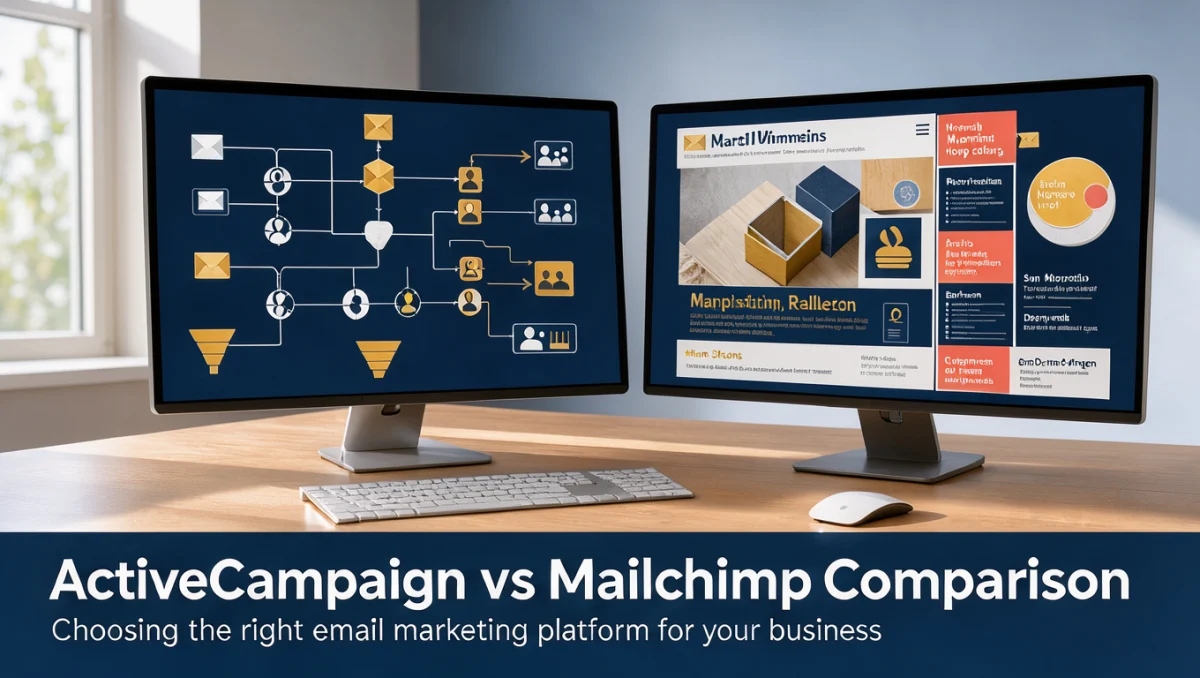
ActiveCampaign provides an automation canvas that supports split paths, multi-condition filters, wait timers, and goal achievements within a single visual workflow. Teams can route subscribers based on previous link clicks, field changes, or pipeline status. Mailchimp provides journey maps for standard drip campaigns, welcome sequences, and transactional receipts, which serve teams that do not require multi-layered conditional branching.
4.2. Contact Management and Segmentation
ActiveCampaign relies on flexible tagging and dynamic custom fields that update automatically through workflow actions. Mailchimp utilizes tags, groups, and audience segments to organize contacts within individual lists. Buyers managing several distinct brands or separate subscriber databases should confirm on the official Mailchimp pricing page how multiple audience lists affect billing calculation.
5. Ease of Use and Navigation
The learning curve of any software platform directly impacts adoption speed and day-to-day productivity. Mailchimp emphasizes a user-friendly drag-and-drop editor that enables rapid email assembly without technical training. ActiveCampaign offers a functional layout, but its dense setting panels and deep automation options demand dedicated configuration time.
5.1. Template Creation Workflow
Mailchimp delivers a polished visual editing interface where users arrange content blocks, images, and buttons with immediate visual feedback. ActiveCampaign provides modern visual design tools as well, though users spend more time connecting emails into wider automated processes. Teams that prioritize rapid design turnaround for seasonal announcements often find Mailchimp more straightforward for basic layouts.
5.2. Campaign Setup and Launch Routine
Creating a one-time broadcast in Mailchimp follows a linear wizard that guides users through recipients, sender information, subject lines, and design review. ActiveCampaign supports similar broadcast processes but places equal emphasis on enrolling recipients into active workflows. For beginners unfamiliar with automation logic, configuring conditions inside ActiveCampaign requires careful review to avoid unintended messaging loops.
6. Pricing Structure and Value Assessment

Both providers utilize subscription billing models that scale according to audience volume and feature access. Subscription software in the marketing category commonly links recurring fees to total contact counts, sending volume, or administrative seat licenses. Evaluating value requires inspecting current tier structures on each vendor site.
6.1. Cost Drivers to Examine
Many email platforms calculate tier thresholds based on stored contacts rather than active recipients, meaning unsubscribed addresses might still count toward monthly totals. Buyers should confirm on the official ActiveCampaign pricing page how contact status changes influence plan boundaries. Similarly, check the official Mailchimp pricing page to understand how audience list counts and contact duplicates impact your monthly invoice.
| What to check on official pages | Why it matters | Who it matters most for |
|---|---|---|
| Contact count definitions | Determines whether unsubscribed records incur charges | Growing businesses with seasonal subscriber spikes |
| Administrative seat limits | Adding team members can trigger plan upgrades | Agencies and collaborative marketing departments |
| Monthly email send volume caps | High-frequency senders may hit volume thresholds | Daily newsletter publishers and e-commerce stores |
7. Integrations and Ecosystem Flexibility
Modern software platforms connect with external databases, e-commerce storefronts, payment gateways, and analytics suites to maintain unified records. ActiveCampaign links closely with customer relationship management systems and custom web hooks to track buyer activity. Mailchimp connects directly with widely used e-commerce systems, landing page builders, and social networks for unified campaign tracking.
7.1. Data Synchronization Across Systems
Marketing teams often require contact data to pass back and forth between checkout portals and email lists without manual CSV imports. When evaluating integrations, confirm on the official ActiveCampaign website how contact fields synchronize with your existing store setup. Check the official Mailchimp website to verify how purchase history and abandoned cart triggers integrate with your store platform.
8. Audience Fit Across Business Types
Software selection succeeds when operational requirements match product focus. A solution that serves a boutique retailer sending weekly announcements may prove restrictive for a software company managing lead nurturing funnels.
8.1. Freelancers and Content Creators
Solo creators and newsletter writers generally benefit from Mailchimp due to straightforward layout generation and minimal technical upkeep. When business revenue depends primarily on occasional editorial letters rather than intricate sales sequences, the streamlined interface of Mailchimp saves operational time.
8.2. Growing Teams and B2B Organizations
ActiveCampaign suits B2B service firms, digital agencies, and expanding commerce operations that require lead scoring and pipeline management. Teams that track prospect engagement through sales discovery calls find value in ActiveCampaign because contact records maintain comprehensive interaction histories across campaigns and pipelines.
8.3. Organizations That Should Look Elsewhere
Enterprise corporations requiring dedicated on-premises deployment, bespoke database customization, or strict physical data isolation should consider specialized enterprise marketing suites. Very large teams with complex compliance rules may find standard subscription tools less flexible for internal governance needs.
9. Support Channels and Assistance
Access to technical guidance becomes vital when setting up automations or resolving domain delivery configurations. Marketing platform providers regularly adjust their support channels, live chat availability, and ticket response times based on subscription level.
9.1. Confirming Support Entitlements
Prospective subscribers should confirm on the official ActiveCampaign support page what communication channels are included with each service tier. Users considering Mailchimp should review the official Mailchimp help page to see whether live chat, ticket submission, or phone assistance aligns with their planned account level. Checking these details beforehand avoids surprises during time-sensitive campaign launches.
10. Competitive Position in the Market
ActiveCampaign and Mailchimp both maintain defined roles within the marketing technology ecosystem. While Mailchimp expanded from newsletter distribution into broader marketing utility, ActiveCampaign centered its development on automation intelligence and customer experience automation. Each platform serves as an established benchmark within its respective operational focus.
11. How to Decide Between the Two Platforms
Choosing between these two systems requires an honest assessment of your technical resources, communication frequency, and sales cycle complexity. Following a structured decision framework prevents premature migrations and wasted subscription budget.
- Define your primary message type: Determine whether your audience primarily receives weekly broadcast newsletters or customized, behavior-triggered sequences.
- Audit internal technical skills: Evaluate whether your team has the capacity to construct and maintain conditional workflows, or if a drag-and-drop editor is preferred.
- Calculate your contact expansion rate: Project subscriber growth over the next twelve months to understand how tier increases affect total operating costs.
- Verify necessary connections: Confirm on official product directories that your payment processors, forms, and administrative tools integrate smoothly.
- Review subscription documentation: Inspect the official ActiveCampaign and Mailchimp pricing pages to confirm seat allocations, contact allowances, and current support policies.
12. Frequently Asked Questions
How should a buyer evaluate automation complexity before choosing?
Map your planned customer journey on paper before selecting a platform. If your communication sequence requires multiple branching paths, conditional delays, and field-based triggers, a dedicated automation architecture like ActiveCampaign is appropriate. If your sequence involves only a basic welcome message followed by weekly newsletters, Mailchimp handles those tasks with less setup effort.
What hidden costs should teams anticipate when adopting marketing software?
Subscription tiers frequently scale based on total database size rather than active monthly recipients. Additional expenses can arise from purchasing extra team seat licenses, integrating third-party data connectors, or employing external specialists for workflow configuration. Reviewing official documentation regarding contact archiving rules helps prevent unexpected subscription jumps.
Should a business switch platforms if current subscriber growth accelerates?
Migrating between email platforms involves transferring contact records, cleaning inactive subscribers, re-authenticating domain records, and rebuilding automated funnels. Teams should only migrate when their current software lacks specific functional capabilities required for revenue generation, rather than switching purely for visual preferences or minor cosmetic interface adjustments.
How does team size influence software selection?
Multi-member marketing departments often require role-based permissions, collaborative workflow authoring, and shared pipeline management. Verify administrative access policies on official product pages to ensure that multiple team members can work simultaneously without requiring costly individual account upgrades.
13. Final Verdict
| Criterion | Score /10 | Reason |
|---|---|---|
| Features | 8.8/10 | Strong automation branching and contact lifecycle controls balance against standard broadcast utilities |
| Ease of Use | 8.2/10 | Mailchimp provides straightforward visual editing while ActiveCampaign requires setup patience |
| Pricing and Value | 7.2/10 | Buyers must inspect subscriber thresholds and seat limits on official pricing pages |
| Integrations | 7.8/10 | Both platforms offer ecosystem connectivity that buyers should confirm prior to checkout |
| Audience Fit | 8.5/10 | Clear distinction between broadcast newsletter creators and behavioral automation teams |
| Support | 7.0/10 | Assistance channels vary across service tiers and require verification on official sites |
| Competitive Position | 8.7/10 | Both solutions maintain clear operational definitions within the marketing software category |
Overall score: 8.0/10
For teams focused on multi-step customer journeys, conditional messaging, and CRM pipeline tracking, ActiveCampaign represents the more functional choice. For businesses, independent operators, and creators who need polished broadcast newsletters with minimal onboarding friction, Mailchimp offers an accessible and capable environment.
Readers with specific operational questions or software comparison inquiries can contact the bestsoftwarereviews team directly through our contact portal or follow bestsoftwarereviews on LinkedIn for regular software updates.