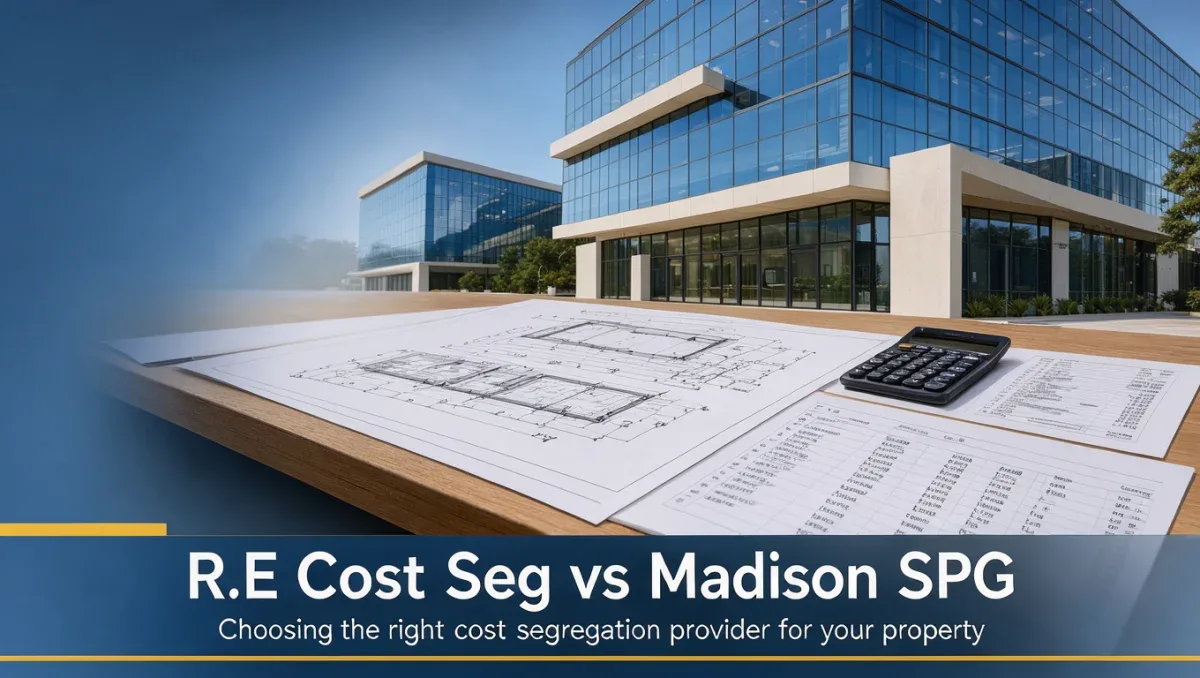
Deciding between R.E. Cost Seg and Madison SPG means choosing between agile, streamlined cost segregation reporting and more intensive, asset-heavy study workflows. The optimal choice hinges on your property's type, the scale of your portfolio, and your readiness for audit defense. At Best Software Reviews, we break down how each provider serves real estate investors and financial professionals.
Accurate depreciation planning is crucial for accelerating tax deductions under current tax laws while mitigating compliance risks. When weighing an R.E cost seg vs madison spg engagement, property owners must meticulously evaluate documentation depth, the necessity of engineering involvement, and the expected reporting timelines to ensure their Accounting filings are supported by compliant documentation.
In essence: Opt for R.E. Cost Seg if you need a rapid turnaround for residential and mid-sized commercial properties requiring straightforward documentation. Choose Madison SPG for complex, large-scale commercial real estate assets that demand specialized engineering assessments. Both R.E. Cost Seg and Madison SPG received an overall score of 8.0/10 from Best Software Reviews.
| Evaluation Metric | R.E. Cost Seg | Madison SPG |
|---|---|---|
| Best Software Reviews Score | 8.0/10 | 8.0/10 |
| Ideal For | Residential rental owners and mid-tier commercial portfolios | Complex commercial facilities and institutional property owners |
| Primary Focus | Accelerated depreciation reporting and structured property asset allocation | Detailed engineering-based studies and comprehensive capital expenditure reviews |
| Consider If | Prioritizing fast turnaround and straightforward residential reporting | Managing high-value commercial buildings with extensive physical improvements |
Understanding Provider Specializations

R.E. Cost Seg excels in delivering accessible cost segregation studies designed to help rental property owners reclassify assets into shorter depreciation schedules. Their operational approach centers on practical asset breakdowns, enabling individual owners and independent accountants to realize immediate deductions without significant administrative burdens.
Conversely, Madison SPG, operating within a broader commercial real estate services network, specializes in institutional-grade cost segregation. They focus on engineering-driven asset analysis and the management of complex property portfolios, catering primarily to commercial developers, real estate syndicates, and corporate property holders who require extensive documentation for stringent audit reviews.
- R.E. Cost Seg emphasizes speed, suitability for residential rentals, and simpler commercial properties.
- Madison SPG concentrates on high-basis commercial structures, industrial assets, and multi-tenant properties.
- Both entities aid tax professionals in distinguishing personal property and land improvements from the main structural assets.
Aligning Services with Your Property Profile
Real estate assets vary greatly in construction type, acquisition basis, and how long they are held. The following matrix helps illustrate how your specific asset profile aligns with each provider's offerings.
| Situation | Choose R.E. Cost Seg If | Choose Madison SPG If |
|---|---|---|
| Single-family rental or small multi-family portfolio | Clear asset schedules are needed promptly, avoiding extended inspection delays. | Residential portfolios are being integrated with larger commercial holdings. |
| Major office park or industrial warehouse | Property improvements adhere to standard, uniform building specifications. | Specialized engineering modeling is required for structural and mechanical allocations. |
| Urgent tax filing deadline approaching | Prompt documentation for your tax preparer is essential. | Your team can accommodate multi-week engineering review cycles. |
| Substantial historical renovations | Invoices and improvement records are well-organized and easy to categorize. | Retrospective allocation is needed for complex structural modifications. |
| Audit defense preference | Reliance is placed on standardized classification tables and basic audit support. | Comprehensive engineering documentation prepared by specialized consultants is preferred. |
| Syndicated investment with multiple passive partners | The partnership agreement supports streamlined depreciation reporting. | Institutional investors expect formal third-party engineering studies. |
Evaluating Cost Segregation Providers Independently
Systematic evaluation during initial consultations is key when assessing cost segregation providers. It's advisable to run your sample property data through both R.E. Cost Seg and Madison SPG using the core criteria below.
Features Assessment
Examine the depth of asset reclassification. Request preliminary reports from both providers to see how building components, site improvements, and personal property are categorized under Modified Accelerated Cost Recovery System (MACRS) standards. Ensure reports clearly delineate five-year, seven-year, and fifteen-year asset categories.
Ease of Use and Documentation
Assess the intake process and required documentation. Inquire about the level of architectural drawings, closing statements, and contractor invoices each team needs. Evaluate how easily your internal bookkeeper or tax advisor can gather the necessary property information.
Pricing and Value Considerations
Cost segregation pricing can range from fixed quotes to variable project assessments. Verify the fee structures on the official R.E. Cost Seg and Madison SPG websites, as pricing adjustments based on building square footage or property basis can significantly impact your total engagement budget.
Integration Capabilities
Determine how seamlessly the study results integrate with your accounting software and tax filing platforms. Confirm with both providers whether they offer exportable spreadsheets that align with the depreciation schedules required by standard tax preparation software.
Audience and Fit Verification
Confirm if the provider routinely handles properties matching your asset class. A service optimized for commercial shopping centers might introduce unnecessary complexity for a portfolio of short-term residential rentals, just as an automated platform could miss specialized deductions on industrial manufacturing plants.
Support and Audit Defense
Audit defense representation is a critical component of tax advisory solutions. Directly inquire with both providers about their audit support services, the availability of expert witnesses, and their response protocols should tax authorities scrutinize the asset reclassification.
Competitive Positioning Analysis
Compare the distinct market positions of both firms. R.E. Cost Seg positions its services for agile execution beneficial to growing real estate investors, while Madison SPG leverages multi-disciplinary commercial real estate expertise for corporate portfolios.
Cost Checklist for Comprehensive Evaluation
The total expenditure for cost segregation extends beyond the initial proposal. Utilize this checklist during provider discovery calls to uncover all potential financial parameters.
| Cost Item | Inquire with R.E. Cost Seg | Inquire with Madison SPG |
|---|---|---|
| Base Study Fee | Confirm if fees are flat or basis-dependent on their official website. | Confirm how baseline study quotes are calculated on their official website. |
| Site Inspection Charges | Check if physical site visits incur additional travel or assessment billing. | Confirm how on-site engineering assessments impact the final proposal. |
| Preliminary Estimate Fee | Verify if initial feasibility estimates require an upfront deposit. | Check if preliminary benefit analyses are provided before engagement. |
| Audit Defense Assistance | Confirm if audit representation is included or billed hourly. | Confirm what documentation and personnel support are included in audit scenarios. |
| Look-Back Study Adjustments | Check if retrospective studies for prior tax years incur supplemental processing costs. | Check fees associated with Form 3115 preparation guidance for catch-up deductions. |
Making the Final Decision
Selecting the ideal provider requires a structured evaluation of your property portfolio and tax objectives. Follow these practical steps before committing to an engagement letter.
- Consult your CPA or tax advisor to ascertain if accelerated depreciation offers benefits for your current taxable income in the upcoming year.
- Gather your property purchase agreement, closing settlement statement, and capital improvement invoices.
- Request a preliminary benefit analysis from both providers to compare projected asset reclassifications.
- Confirm engagement terms, delivery schedules, and audit defense protocols with each team.
- Choose the provider whose report structure best matches your building's complexity and your tax preparer's requirements.
Frequently Asked Questions
When is it advisable to switch cost segregation providers?
Property owners often switch providers when transitioning from simpler residential properties to more complex commercial facilities. If your portfolio expands to include specialized industrial buildings, the need for expert commercial engineering becomes paramount. Conversely, owners shifting towards uniform residential assets may seek streamlined reporting to minimize administrative delays.
How do accountants prefer cost segregation data?
Accountants generally prefer receiving clear asset allocation schedules detailing specific recovery periods. The report should explicitly separate personal property, land improvements, and structural components. It is wise to verify with your tax professional if they require specific depreciation schedule formats before your chosen provider commences work.
Can these studies accommodate prior-year property acquisitions?
Yes, both providers can address properties acquired in prior tax years through what are known as look-back studies. Catch-up depreciation enables property owners to claim missed deductions without the need to amend past tax returns. Consult your CPA regarding the process for filing depreciation adjustments via accounting method changes.
How does property size influence the choice between these providers?
Property size directly impacts the necessary depth of inspection. Smaller residential buildings often allow for straightforward asset splits without extensive mechanical engineering. Large commercial structures with specialized HVAC systems, custom electrical installations, and significant land improvements necessitate the engineering depth typically offered by institutional providers.
Conclusion
Both R.E. Cost Seg and Madison SPG offer valuable depreciation acceleration benefits, but they cater to distinct segments within the real estate investment landscape. The table below summarizes the comparative scores assigned by Best Software Reviews across our standardized evaluation framework.
| Criterion | R.E. Cost Seg Score /10 | Madison SPG Score /10 | Rationale |
|---|---|---|---|
| Features | 8.0 | 8.5 | Madison SPG provides more in-depth engineering analysis for complex commercial structures, while R.E. Cost Seg focuses on essential component reclassifications. |
| Ease of Use | 8.5 | 7.5 | R.E. Cost Seg offers a more streamlined intake process for standard properties, whereas Madison SPG requires extensive building documentation. |
| Pricing and Value | Confirm Before Buying | Confirm Before Buying | Verify fee structures on each official website, as property basis and building complexity affect total engagement costs. |
| Integrations | Confirm Before Buying | Confirm Before Buying | Confirm reporting export formats on each official website to ensure compatibility with your CPA's tax preparation software. |
| Audience Fit | 7.5 | 8.0 | Madison SPG aligns closely with institutional commercial developers, while R.E. Cost Seg serves residential landlords and medium-sized holdings effectively. |
| Support | Confirm Before Buying | Confirm Before Buying | Directly confirm audit defense terms and expert consultation availability on each official provider page. |
| Competitive Position | 8.0 | 8.0 | Both firms maintain distinct competitive positions, respectively tailored to agile residential investors and institutional commercial portfolios. |
| Overall Score | 8.0 | 8.0 | Balanced performance reflecting specialized strengths across different property asset classes. |
For independent landlords and growing residential portfolios, R.E. Cost Seg presents an efficient path to accelerated depreciation. For high-value commercial properties, industrial sites, and institutional real estate partnerships, Madison SPG provides the rigorous engineering methodology essential for complex asset protection. Always discuss tax depreciation strategies with a qualified CPA or tax advisor before finalizing any building component reclassifications.
Have a question about choosing software? Send it to the Best Software Reviews team via our contact page, or follow us on LinkedIn for the latest reviews and comparisons.